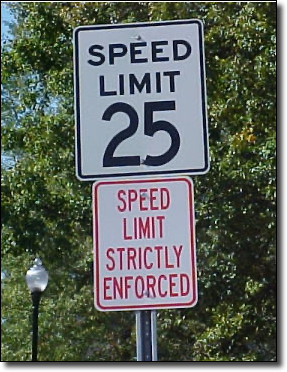
SpeedSlowing down allows you more time to observe details in urban driving environments, like pedestrians, road hazards, and traffic patterns. It also gives you the chance to analyze what you see, anticipate potential situations, react quickly to hazards, and make safe decisions to change direction or avoid danger. Speeding is a common cause of traffic violations. In California, while there’s no minimum speed limit, you must not drive so slowly that it becomes unsafe. You should reduce your speed when:
There are specific speed limits you must adhere to even without posted signs:
You must also maintain a lower speed limit when passing school grounds or a senior center. Sometimes, lower speed limits are posted near schools in addition to the main school zone signs. Look out for marked crosswalks and signs indicating school zones. Note: Every state has a basic speed law. In California, it’s defined in the Vehicle Code: Section 22350: No person shall drive a vehicle upon a highway at a speed greater than is reasonable or prudent having due regard for weather, visibility, the traffic on, and the surface and width of, the highway, and in no event at a speed which endangers the safety of persons or property. |
|
Text
Text
Text
Sharing the roadway safely with other drivers, pedestrians, and cyclists is crucial for preventing accidents and ensuring everyone’s safety. The Golden Rule of DrivingTreat other road users the way you’d want to be treated. This means following traffic laws, driving responsibly, and avoiding unnecessary risks. |
The car isn’t the only thing that can have “breakdowns.” The driver must also be in top condition to safely operate on today’s highways.
In order to drive safely, you must be in good physical condition. In particular, you need to be able to see and hear well enough to detect potential hazards and handle emergency situations.
All drivers are subject to the natural laws and laws of physics that affect any moving, or stationary, object. There are many natural forces acting on your vehicle, such as:
These forces affect how your vehicle handles, regardless of how well your vehicle is designed or how skilled you are at handling it.
Understanding these forces will help you control your vehicle during turns, stops, and everyday driving conditions. Knowing how they affect driving your vehicle may also help you react appropriately to an emergency situation or avoid a collision.
Otherwise, you may lose control of your vehicle and could cause an accident that could have been prevented.
By misjudging natural forces, you can be pulled out of a curve and lose control. You may lose traction on wet pavement and be unable to stop or be traveling too fast to stop quickly in heavy traffic and cause an accident.
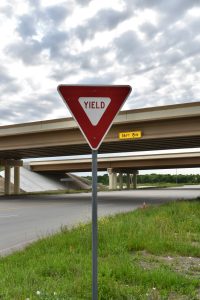 The shape and color of a sign offers you a clue about the information contained on the sign. Here are the common shapes used:
An 8-sided red STOP sign indicates that you must make a full stop whenever you see this sign. Stop at the white limit line (a wide white line painted on the street) or before entering the crosswalk. If a limit line or crosswalk is not painted on the street, stop before entering the intersection. Check traffic in all directions before proceeding.
A 3-sided red YIELD sign indicates that you must slow down and be ready to stop, if necessary, to let any vehicle, bicyclist, or pedestrian pass before you proceed. Yield means to give the right-of-way to traffic on the road you are entering or crossing.
A square red and white regulatory sign may have different instructions. For example, the DO NOT ENTER sign means do not enter a road or off ramp where the sign is posted (usually on a freeway off ramp). The WRONG WAY sign may or may not be posted with the DO NOT ENTER sign. If you see one or both of these signs, drive to the side of the road and stop. You are going against traffic. When safe, back out or turn around and return to the road you were on. At night if you are going the wrong way, the road reflectors will shine red in your headlights.
A sign that has a red circle with a red line through it always indicates “NO.” The picture inside the circle shows what you cannot do. The sign may be shown with or without words.
A yellow and black circular sign indicates that you are approaching a railroad crossing.
An X-shaped sign with a white background that states RAILROAD CROSSING indicates that you must look, listen, slow down, and prepare to stop, if necessary. Let any trains pass before you proceed.
A 5-sided sign indicates that you are near a school. Stop if children are in the crosswalk.
A 4-sided diamond-shaped sign warns you of specific road conditions and dangers ahead. Many warning signs are diamond shaped.
A white rectangular sign indicates that you must obey important rules.
Some warning signs have a fluorescent yellow-green background. These signs warn of conditions related to pedestrians, bicyclists, schools, playgrounds, school buses, and school passenger loading zones. Obey all warning signs regardless of their shape or color.
Photo by Greg Jewett on Unsplash
There is more than just one type of driver license; different types and classes of licenses and instruction permits are required and issued for various types of vehicles depending on:
If you choose to get a REAL ID, the following video will help explain what’s involved.
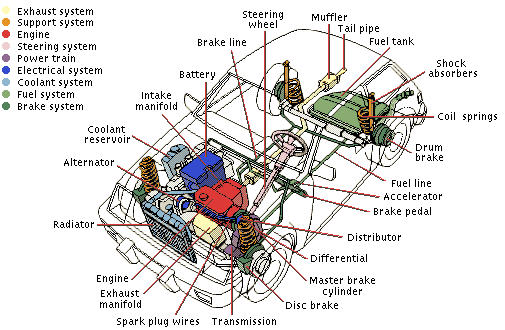
Traditionally, a vehicle had 8 “systems” that made up the basics of the vehicle. Lately, a ninth system, the “support system” has been added, due to the complexities of computerization and crash-safety.
Several of these systems are important to you, the driver, for the safe operation of your vehicle, and state law requires that you have a “working knowledge” of them.
The following pages will show some of the basics of these systems.
Reducing speed allows more time to see details of the urban driving environment such as pedestrians, road hazards, and traffic flow. It also allows time to analyze what you see and predict what might happen, react to any hazards that might require quick reflexes, and execute decisions to safely change directions and avoid hazardous situations.
Many traffic violations involve speeding. Although there is no minimum speed limit in California, there is a law that requires you to not drive so slowly as to be unsafe.
You should reduce your speed when:
There are special speed limits you must follow even if there is no sign erected, including:
You should follow the same speed limit when passing school grounds when children are present, and when passing a senior center.
Sometimes lower speed limits are posted in the general vicinity of schools in addition to the school itself. Specially marked crosswalks and five-sided signs warns that you are approaching or are in the presence of a school.
NOTE: All 50 states have a basic speed law. In California, the Vehicle Code spells it out:
22350 – No person shall drive a vehicle upon a highway at a speed greater than is reasonable or prudent having due regard for weather, visibility, the traffic on, and the surface and width of, the highway, and in no event at a speed which endangers the safety of persons or property.
Traffic accidents are one of the top 5 causes of death in the United States. Although some accidents are unavoidable, the sad truth is that thousands of lives would be saved each year if drivers were aware of the conditions that increase the risk of an accident and took defensive steps to drive safely.
Although drivers under 30 years of age account for only about 23% of licensed drivers, they comprise about 35% of all drivers in fatal and injury collisions. Teenage drivers have total accident rates which are 4 times that of adults. Traffic accidents are the leading cause of death for teenagers.
Faulty Driver Performance
As was discussed in Lesson 3, there are physical abilities that are necessary for avoiding accidents. Physical conditions that can lead to accidents include poor vision, poor hearing, illness, and fatigue.
Vision
Good vision is important for safe driving and avoiding accidents. You need to have good visual acuity, peripheral vision, depth perception, and glare resistance and recovery. Good vision allows you to identify potential hazards and react more quickly. You should have your vision checked and wear prescription lenses when necessary. Keep your windows and mirrors clean and don’t hang things from your mirrors or windows that could block your view. Accidents can happen if you don’t check blind spots. Make sure to turn your head before merging into a lane during a lane change or before making a turn.
Hearing
Good hearing is also necessary for safe driving and avoiding accidents, so be sure to get it checked periodically. Your hearing can help you notice vehicles in your blind spots. Make sure to have your hearing checked periodically. In order to be aware of your surroundings, keep your radio turned down. Driving with at least one of your side windows open will also allow you to hear what is going on outside your vehicle better.
Driving with headphones or earbuds is illegal.
Safely sharing the roadway with other drivers and pedestrians is essential for avoiding accidents.
The golden rule of driving is to treat other drivers the way you want to be treated. You should obey traffic laws, drive responsibly, and avoid taking unnecessary risks.
In this lesson, you will learn about topics like: